
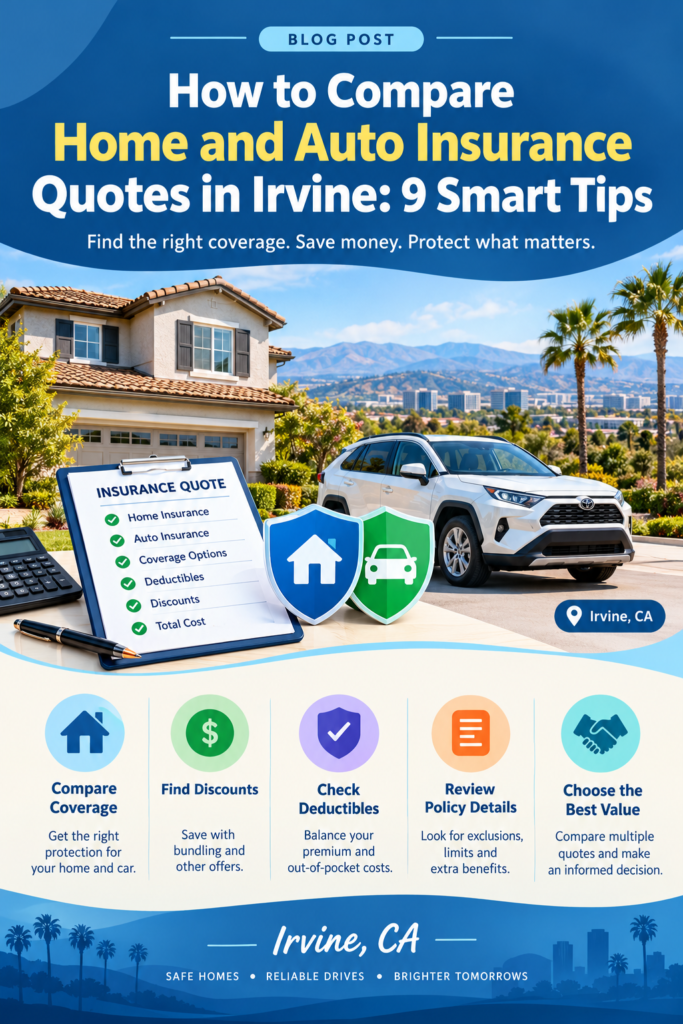
Compare Home and Auto Insurance Quotes in Irvine: 9 Smart Tips
If you want to compare home and auto insurance quotes in Irvine, CA, look beyond the monthly premium. The right comparison considers coverage limits, deductibles, exclusions, available discounts, and the total cost of protecting your home and vehicles. Comparing bundled and separate policies can help Irvine residents find suitable coverage without paying for protection they do not need.
Whether you live in Woodbridge, Northwood, Turtle Rock, or near Irvine Spectrum, getting multiple insurance quotes can help you make a more informed decision. This guide explains how to compare policies, evaluate bundling offers, and choose coverage that fits your household and budget.
Quick Overview: Comparing Home and Auto Insurance in Irvine
Start by requesting home and auto insurance quotes using the same personal details and coverage limits. Compare the bundled price with the combined price of separate policies, then review deductibles, liability limits, exclusions, and discounts. The lowest quote is not always the best value if it leaves you with inadequate coverage after an accident or property loss.
TL;DR: Key Takeaways
- Request quotes from multiple insurance companies before choosing a policy.
- Compare bundled home and auto insurance against separate policies.
- Use the same coverage limits and deductibles for a fair comparison.
- Review dwelling replacement cost, personal property protection, and liability coverage.
- Check California auto insurance requirements and consider whether higher liability limits suit your circumstances.
- Ask about multi-policy, safe-driver, home safety, and other available discounts.
- Review exclusions, claims service, and policy conditions instead of choosing on price alone.
Table of Contents
- Why Compare Home and Auto Insurance Quotes in Irvine?
- Does Bundling Home and Auto Insurance Save Money?
- 9 Steps to Compare Insurance Quotes
- What Coverage Should You Compare?
- What Affects Insurance Costs in Irvine?
- Common Insurance Comparison Mistakes
- Official California Insurance Resources
- Frequently Asked Questions
Why Compare Home and Auto Insurance Quotes in Irvine?
Homeowners often focus on one policy at a time, but home and auto insurance together can represent a substantial part of a household’s annual expenses. Comparing both policies at once gives you a clearer view of your total insurance costs and whether a multi-policy discount is worthwhile.
Insurance companies assess different factors when calculating premiums. Home insurance pricing may depend on the home’s replacement cost, age, construction, deductible, claims history, and available underwriting options. Auto insurance pricing may depend on driving history, vehicle characteristics, mileage, location, selected coverage, and other rating factors permitted by California law.
Two companies can offer different prices for policies that appear similar. Reading the coverage details helps you understand whether the difference comes from the price, the deductible, the coverage limits, or exclusions.
Does Bundling Home and Auto Insurance Save Money?
Bundling means purchasing home and auto insurance from the same insurance company or insurance group when the provider offers that option. A qualifying household may receive a multi-policy discount, but savings are not guaranteed and vary by insurer, eligibility, and policy.
For example, one company might offer a lower auto premium but a higher home premium. Another might have a larger bundle discount but more restrictive coverage options. Compare the total annual cost and the protection offered by each option.
Bundled Insurance vs. Separate Policies
| Comparison factor | Bundled policies | Separate policies |
|---|---|---|
| Pricing | May include a multi-policy discount | May be cheaper if individual insurers offer better rates |
| Convenience | May simplify billing and policy management | May require managing different accounts |
| Coverage choices | Depends on the provider’s available policies | Can allow more flexibility between insurers |
| Claims support | Depends on the company and type of claim | Each claim is generally handled by the relevant insurer |
| Best approach | Compare the total price and policy terms | Compare the combined cost and coverage quality |
Practical tip: Ask each provider for the home premium, auto premium, available discounts, and final combined annual cost. This makes it easier to compare offers fairly.
9 Steps to Compare Home and Auto Insurance Quotes in Irvine
1. Gather Your Home and Vehicle Information
Prepare your home’s address, approximate year built, square footage, construction details, safety features, and estimated rebuilding needs. For your vehicle, gather the year, make, model, vehicle identification details, annual mileage, and driver information requested by the insurer.
Accurate information helps reduce discrepancies between quotes and the final policy offer.
2. Request Quotes From Multiple Insurers
Contact several insurance companies or a licensed insurance professional who can help you explore available options. Ask for quotes for both home and auto coverage, including a combined offer when available.
For a starting point, review the California Department of Insurance’s insurance premium comparison resources. Published comparisons are guides rather than personalized offers, so confirm your actual price directly with the insurer.
3. Keep Coverage Limits Consistent
A meaningful comparison requires similar coverage. If one auto quote includes higher liability limits or one home quote includes a different dwelling limit, the premiums may not be directly comparable.
Ask each provider to quote the same or closely matched limits, deductibles, and optional protections wherever possible.
4. Compare Home Insurance Protection
Review dwelling coverage, personal belongings, personal liability, loss of use, and other applicable protections. Make sure the dwelling limit reflects the estimated cost to rebuild the house, not simply its market value or purchase price.
Check exclusions and special limits for valuables. Standard homeowners policies generally do not cover earthquake or flood damage in the same way as dedicated policies or endorsements, so review the contract and discuss any additional protection you may need.
5. Review Auto Insurance Liability Limits
California has minimum auto liability insurance requirements, but meeting the legal minimum does not necessarily mean you have enough protection for your financial circumstances.
Compare bodily injury liability, property damage liability, uninsured or underinsured motorist coverage when applicable, collision, and comprehensive coverage. Ask a licensed insurance professional which limits and optional coverages fit your situation.
Read the state’s California DMV auto insurance requirements before finalizing your decision.
6. Compare Deductibles and Out-of-Pocket Costs
A deductible is the amount you generally pay toward a covered claim before your insurance pays the remaining eligible amount, subject to the policy terms. A higher deductible can reduce the premium, but it also means you may need more savings available after a loss.
Compare the deductible on each policy and make sure you could reasonably afford it. For home insurance, also check whether certain types of damage have separate deductibles or coverage conditions.
7. Ask About Available Discounts
Ask insurers whether you qualify for a multi-policy discount, safe-driver discount, vehicle safety discount, home security discount, or other available savings. Eligibility rules and discount amounts vary by company.
Do not assume that the largest advertised discount produces the lowest final premium. Compare the actual prices after eligible discounts are applied.
8. Check Exclusions, Service, and Policy Conditions
Read the policy documents or request a clear explanation of important exclusions, coverage limits, renewal terms, and claims procedures. Ask how the company handles claims and what documentation it requires after a loss.
Price matters, but so does understanding what the contract will and will not cover.
9. Compare the Final Annual Cost Before You Buy
Make a final comparison that includes both premiums, deductibles, coverage limits, discounts, and any additional policies you may need. Confirm the effective dates and avoid creating a gap in existing coverage when switching providers.
Once you have reviewed the details, choose the option that offers the most suitable combination of cost, coverage, and service for your household.
What Coverage Should You Compare?
Home Insurance Coverage Checklist
| Coverage | What to review |
|---|---|
| Dwelling | Whether the limit reflects estimated rebuilding costs |
| Personal property | Limits, covered belongings, and special limits for valuables |
| Personal liability | Protection for covered claims involving injury or property damage to others |
| Loss of use | Eligible additional living expenses after a covered loss |
| Deductibles | Standard and any separate deductibles or conditions |
| Exclusions | Flood, earthquake, maintenance issues, and other policy-specific exclusions |
Auto Insurance Coverage Checklist
| Coverage | What to review |
|---|---|
| Liability | Whether the limits suit your financial exposure |
| Collision | Coverage for qualifying collision damage to your vehicle |
| Comprehensive | Protection for covered non-collision losses |
| Uninsured or underinsured motorist | Availability, limits, and policy conditions |
| Medical payments | Whether the optional coverage is available and appropriate |
| Deductibles | Your cost before eligible collision or comprehensive benefits apply |
What Affects Insurance Costs in Irvine?
There is no single home or auto insurance price that applies to every Irvine household. Premiums depend on individual circumstances, insurer underwriting, coverage selections, and current availability.
- Home characteristics: Age, construction, condition, replacement cost, and protective features can affect eligibility and pricing.
- Location and risk: Insurers may consider location-specific risks, including certain natural hazards and claims patterns.
- Driving history: Driving experience, eligible driving records, vehicle use, and other permitted rating factors can affect auto pricing.
- Vehicle type: Repair costs, safety features, vehicle value, and other characteristics can influence premiums.
- Coverage choices: Higher limits, additional protections, and lower deductibles can change the price.
- Discount eligibility: Discounts may be available for qualifying drivers, homes, or bundled policies.
How to Compare Insurance Quotes: An Illustrative Example
The following example demonstrates how to compare combined costs. These figures are hypothetical and are not actual Irvine quotes, market averages, or a prediction of your premium.
| Option | Annual home premium | Annual auto premium | Combined annual cost |
|---|---|---|---|
| Insurer A, bundled | $1,600 | $1,800 | $3,400 |
| Insurer B, bundled | $1,750 | $1,500 | $3,250 |
| Separate insurers | $1,500 | $1,650 | $3,150 |
In this hypothetical example, the separate policies have the lowest combined premium. However, you would still need to compare coverage limits, deductibles, exclusions, service, and eligibility before deciding which option offers the best value.
Common Mistakes When Comparing Insurance Quotes
- Choosing the cheapest premium automatically: A lower price may come with lower limits or less coverage.
- Comparing different coverage levels: Use consistent limits and deductibles whenever possible.
- Assuming bundling always saves money: Compare the combined price against separate policies.
- Using market value as rebuilding cost: The cost to rebuild a home can differ from its sale price.
- Ignoring exclusions: Understand what is not covered before purchasing a policy.
- Forgetting the renewal date: Plan a switch carefully to avoid a gap in coverage.
- Providing inaccurate information: Incorrect details can lead to revised quotes or coverage problems.
Where to Find Reliable California Insurance Information
Use official sources to understand coverage options and California insurance requirements. These resources can help you ask better questions when comparing personalized quotes.
- California Department of Insurance: Consumer guidance, insurance information, and regulatory resources.
- California insurance premium comparison resources: Reference information for comparing premiums.
- California auto insurance comparison tool: A resource for reviewing auto insurance premium information.
- California homeowners insurance comparison tool: A resource for reviewing homeowners premium information.
- Homeowners coverage comparison tool: A resource for examining homeowners coverage differences.
- California DMV insurance requirements: Official information about vehicle insurance requirements.
Compare Home and Auto Insurance Quotes in Irvine With Personalized Guidance
Finding suitable coverage starts with understanding your household’s needs and comparing options carefully. California Insurance Quotes can help you explore insurance options and connect with Julie Wong Insurance, TWFG, for guidance on coverage choices and quote comparisons.
Whether you are reviewing an existing policy, insuring a new home, or looking for a home and auto bundle, ask for a clear breakdown of premiums, deductibles, limits, and available discounts.
Ready to compare your options? Visit California Insurance Quotes to get started.
- Phone: 949-606-4778
- Email: jwong@twfg.com
- Office: 1706 W Orangethorpe Ave, Fullerton, CA 92833
You can also explore our insurance services and learn more about our team.
Frequently Asked Questions
How do I compare home and auto insurance quotes in Irvine?
Request quotes from multiple insurers using consistent coverage limits and deductibles. Compare the combined annual premium, available discounts, exclusions, claims support, and policy conditions before making a decision.
Is it cheaper to bundle home and auto insurance in Irvine?
Bundling may qualify you for a multi-policy discount, but it is not always the cheapest option. Compare the bundled price with the combined cost of separate policies and check that the coverage is comparable.
How many insurance quotes should I compare?
Start with at least three comparable quotes when practical. The best number depends on availability, your coverage needs, and how much the offers differ.
What information do I need to get insurance quotes?
You may need your home address, property details, vehicle information, driver details, current coverage, claims history, and desired limits. Requirements vary by insurer.
Does a home insurance policy cover floods and earthquakes in California?
Standard homeowners policies generally exclude flood and earthquake damage, although exact policy terms vary. Review the exclusions and ask about separate coverage or endorsements if you need additional protection.
Should I choose the lowest insurance quote?
Not automatically. Check coverage limits, deductibles, exclusions, insurer service, and the total cost. A slightly higher premium may be worthwhile if it provides protection better suited to your needs.
Where can I compare California home and auto insurance information?
You can start with the California Department of Insurance and its premium comparison resources, then request personalized quotes from insurers or a licensed insurance professional.
Final Thoughts
When you compare home and auto insurance quotes in Irvine, focus on the full picture rather than the advertised premium. Consistent coverage limits, realistic deductibles, a review of exclusions, and a comparison of bundled and separate policies can help you make a more informed choice.
Take time to review the details, ask questions about anything unclear, and choose coverage that fits your household’s needs and budget.
Insurance availability, discounts, eligibility, and policy terms vary by insurer. This article provides general educational information and is not a binding quote or a guarantee of savings. Confirm coverage and pricing directly with a licensed insurance professional.
One Response