

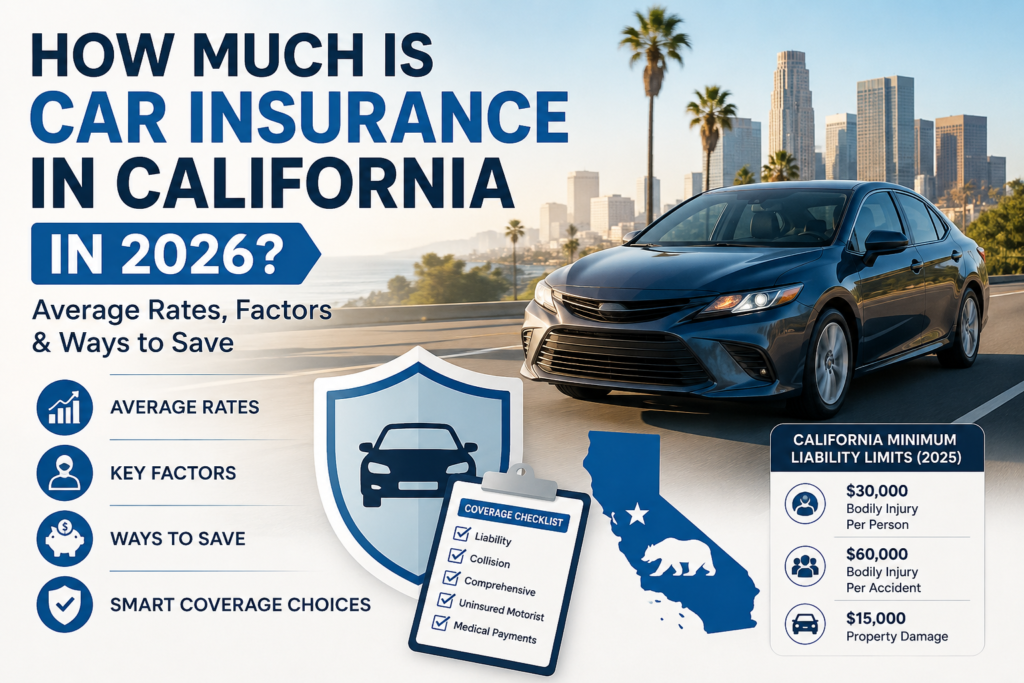
How Much Is Car Insurance in California in 2026? Average Rates, Factors & Ways to Save
Quick Answer
Car insurance in California can vary widely depending on your driving record, age, location, vehicle, annual mileage, coverage limits, deductible, and other rating factors. There is no single price that applies to every driver. The best way to find your actual 2026 rate is to compare personalized California car insurance quotes using the same coverage limits and deductibles.
Key Takeaways
- California car insurance prices vary significantly from one driver to another.
- Your ZIP code, driving history, vehicle, mileage, coverage, and other factors can affect your premium.
- California’s current minimum liability requirements are $30,000 per person/$60,000 per accident for bodily injury and $15,000 for property damage.
- Minimum coverage is generally less expensive than broader protection, but it also provides less financial protection.
- Comprehensive and collision coverage can increase your premium but may make sense for newer, financed, leased, or higher-value vehicles.
- Comparing quotes is one of the most practical ways to look for competitive pricing.
- The cheapest policy is not automatically the best policy.
- California drivers should compare policies using equivalent coverage limits rather than comparing monthly prices alone.
- A licensed insurance professional can help you understand the differences between quotes before you choose a policy.
TL;DR
If you’re wondering how much car insurance costs in California in 2026, the honest answer is: it depends.
Two California drivers can receive very different quotes even when they drive similar cars. Insurers consider factors such as driving history, location, vehicle characteristics, annual mileage, selected coverage, deductibles, and other underwriting information.
California’s current minimum liability requirements are $30,000 per injured person/$60,000 per accident for bodily injury and $15,000 for property damage.
For many drivers, the smartest approach isn’t simply looking for the lowest advertised price. It’s comparing several quotes with the same coverage limits and deductibles and then choosing a policy that provides an appropriate balance between cost and protection.
Entity Overview
| Entity | Details |
|---|---|
| Brand | California Insurance Quotes |
| Service | California Car Insurance / Auto Insurance |
| Location | California |
| Industry | Personal Insurance / Auto Insurance |
| Phone | 949-606-4778 |
| Website | CaliforniaInsuranceQuotes.com |
California Insurance Quotes helps California residents compare insurance options from trusted carriers. The company offers several insurance solutions, including car, home, business, life, umbrella, and workers’ compensation insurance.
For car insurance specifically, California Insurance Quotes focuses on helping California drivers understand coverage options and compare policies based on their individual circumstances.
What Is Car Insurance in California?
Car insurance is a financial protection policy designed to help cover certain costs resulting from accidents, vehicle damage, injuries, theft, and other covered events.
California requires drivers to maintain minimum financial responsibility requirements. For standard private passenger automobile policies, the current minimum liability limits are:
| Coverage | California Minimum |
|---|---|
| Bodily injury – one person | $30,000 |
| Bodily injury – one accident | $60,000 |
| Property damage | $15,000 |
These limits increased beginning with policies renewing in 2025 under California law.
However, meeting the legal minimum doesn’t necessarily mean you have enough protection for your particular situation.
For example, imagine you cause an accident involving multiple people and the total medical bills and other damages are much greater than your liability limits. Your insurance may only pay up to the applicable policy limit, potentially leaving additional financial exposure.
That’s why California drivers should consider both legal requirements and personal financial risk when selecting coverage.
Before choosing a policy, you can review our California insurance services to understand the different coverage options available.
Why Does Car Insurance Cost So Much in California?
California is a large and highly populated state with significant differences between communities.
Your insurance company doesn’t simply look at “California” and assign everyone the same price.
Your premium can be influenced by characteristics associated with your individual risk profile and the vehicle being insured.
Driving History
A clean driving record can make a meaningful difference when compared with a record containing accidents or violations.
Insurers may consider:
- At-fault accidents
- Traffic violations
- Claims history
- Driving experience
- Other applicable driving information
The fewer risk indicators you have, the better your insurance profile may be.
Where You Live
Your location can affect your rate.
For example, insurance risk can differ between densely populated areas and less populated communities because factors such as traffic, accident frequency, theft, and claims patterns may vary.
Your Vehicle
The car you drive matters too.
Factors can include:
- Vehicle make
- Model
- Year
- Repair costs
- Safety equipment
- Theft risk
- Replacement value
Different vehicles can have very different insurance costs, even when they are owned by the same driver.
How Much You Drive
Someone who drives a few thousand miles annually may present a different risk profile from someone commuting long distances every weekday.
Your estimated annual mileage can therefore be relevant when you request a quote.
Coverage Selections
A liability-only policy generally costs less than a policy that includes comprehensive and collision coverage.
That’s because broader coverage can protect against additional types of losses.
Deductibles
A deductible is the amount you generally pay toward a covered loss before your insurer pays the remaining covered amount, subject to the policy terms.
Changing your deductible can affect your premium.
But don’t choose a deductible solely because it produces the lowest monthly payment. Make sure you could realistically afford it after a covered loss.
How Does California Car Insurance Work?
California generally follows an at-fault system for auto accidents.
If you cause an accident, your liability coverage can help pay for covered injuries or property damage you cause to others, up to your policy limits.
However, your own vehicle isn’t automatically protected by liability coverage.
That’s where optional coverages such as collision and comprehensive can become important.
Liability Coverage
Liability insurance is designed to protect you when you are legally responsible for covered injuries or property damage to another party.
Collision Coverage
Collision coverage can help pay for covered damage to your vehicle resulting from a collision, subject to your policy terms and deductible.
Comprehensive Coverage
Comprehensive coverage can protect against certain non-collision events, such as theft, vandalism, fire, and other covered causes.
Uninsured and Underinsured Motorist Coverage
California requires insurers to offer uninsured/underinsured motorist bodily injury coverage, although consumers may reject or modify it in writing under applicable rules.
This coverage can be particularly important because not every driver on the road carries enough insurance to cover a serious accident.
Step-by-Step Process: How to Find Affordable Car Insurance in California
Step 1: Understand Your Current Policy
Before shopping, look at:
- Liability limits
- Comprehensive coverage
- Collision coverage
- Deductibles
- Uninsured/underinsured motorist coverage
- Medical payments
- Optional endorsements
This gives you a baseline for comparing new quotes.
Step 2: Gather Your Driver Information
You may need:
- Driver’s license information
- Address
- Driving history
- Previous insurance information
- Household driver information
Step 3: Gather Vehicle Information
Have your:
- Vehicle year
- Make
- Model
- Mileage
- VIN, if required
- Vehicle usage information
Step 4: Decide What Protection You Need
Don’t start with price alone.
Think about your vehicle’s value, your financial situation, how frequently you drive, and whether the vehicle is financed or leased.
Step 5: Compare Multiple Quotes
Request quotes from multiple insurers or work with an insurance professional who can help you compare available options.
Step 6: Make the Comparison Apples-to-Apples
This is one of the most important steps.
If Company A quotes $150 per month with high liability limits and comprehensive/collision while Company B quotes $100 for minimum liability only, the $100 policy isn’t necessarily the better deal.
The coverage isn’t equivalent.
Step 7: Review the Policy Before Buying
Check:
- Coverage limits
- Deductibles
- Exclusions
- Discounts
- Payment schedule
- Effective date
- Drivers listed on the policy
Step 8: Re-Shop Periodically
Your insurance needs can change.
A new vehicle, change in mileage, new household driver, move, improved driving record, or change in financial circumstances can all be reasons to review your coverage.
Comparison Table
| Feature | Minimum Liability | Broader / Full Coverage |
|---|---|---|
| Bodily injury liability | Yes | Yes |
| Property damage liability | Yes | Yes |
| Collision | No | Typically included |
| Comprehensive | No | Typically included |
| Protection for your vehicle | Limited | Broader |
| Typical premium | Lower | Higher |
| Best for | Drivers prioritizing basic legal protection | Drivers wanting broader financial protection |
| Deductible | Usually not applicable to liability | Often applies to comprehensive/collision |
| Protection level | Basic | More extensive |
Important: “Full coverage” isn’t a single standardized insurance product. The exact coverages and limits depend on the policy.
Cost Breakdown
There isn’t one universal “California car insurance price.”
Instead, think of your premium as the result of multiple variables.
| Factor | Potential Impact |
|---|---|
| Driving record | Can significantly affect pricing |
| Location | Can influence risk and premium |
| Vehicle | Repair, replacement, and claim risk matter |
| Annual mileage | More driving can mean more exposure |
| Coverage limits | Higher limits generally provide more protection and may cost more |
| Deductibles | Higher deductibles may reduce premiums |
| Vehicle use | Personal vs. business use can affect pricing |
| Driver profile | Age and experience can influence rates |
| Discounts | Eligible discounts can reduce premiums |
Why Online Average Rates Can Be Misleading
An average is useful for general research, but it isn’t a personalized quote.
Suppose one driver is 45 years old with a clean record, drives an older sedan, and has relatively low annual mileage.
Another driver might be 20, have a recent ticket, drive a newer sports car, and commute long distances.
Their insurance prices could be dramatically different.
That is why your actual quote matters more than a national average.
Statistics & Research
California’s insurance requirements have changed in recent years.
Beginning January 1, 2025, standard California auto policies moved to higher minimum liability limits of $30,000 per person/$60,000 per accident for bodily injury and $15,000 for property damage.
The California Department of Insurance also provides consumers with automobile premium comparison resources and standard coverage-limit information.
For additional industry context, individual insurers publish their own California pricing information. However, insurer-specific averages should not be confused with an official statewide average because the underlying customer populations and policies can differ.
For current requirements and consumer resources, visit the California Department of Insurance.
Expert Insights
1. Don’t Shop for a Number—Shop for Protection
A $20 monthly difference isn’t necessarily meaningful if the cheaper policy has substantially lower limits or fewer protections.
2. Compare Identical Coverage
When comparing companies, keep your liability limits, deductibles, and optional coverage as similar as possible.
This makes the price comparison much more useful.
3. Ask About Discounts
Depending on the insurer and your eligibility, discounts may be available for things such as:
- Multiple vehicles
- Bundling policies
- Safety features
- Driver training
- Certain driver profiles
- Other qualifying factors
Don’t assume a discount exists everywhere. Ask the insurer or agent which discounts apply to your specific situation.
4. Don’t Automatically Choose the Highest Deductible
A higher deductible can sometimes reduce the premium, but you need to be comfortable paying that amount after a covered loss.
5. Review Your Policy Every Year
Your insurance shouldn’t be treated as a “set it and forget it” purchase.
Life changes. Your insurance should change with it.
Real-World Examples
Example 1: Clean-Record Driver
Imagine a California driver with several years of driving experience, no recent accidents, no recent tickets, moderate annual mileage, and an older vehicle.
This driver may decide that liability coverage is sufficient for their situation, particularly if the vehicle has limited market value.
Example 2: Newer Vehicle
Now consider someone with a newer vehicle.
They may want comprehensive and collision coverage because repairing or replacing the vehicle after a covered loss could be financially significant.
Example 3: High-Mileage Commuter
A driver commuting long distances every day may have different insurance considerations from someone who drives occasionally.
The additional mileage may affect the quote.
Example 4: Comparing Two Quotes
Imagine:
- Quote A: $140/month
- Quote B: $115/month
At first glance, Quote B looks better.
But suppose Quote A includes higher liability limits and comprehensive/collision while Quote B only provides minimum liability.
The $25 difference isn’t really a price comparison between equivalent policies.
That’s why coverage comes first.
Case Study
A Hypothetical California Driver Shopping for Lower Premiums
Consider a California driver who notices their renewal premium has increased.
Instead of immediately choosing the cheapest available policy, they take the following approach:
- Review their existing coverage.
- Check their driving record.
- Confirm annual mileage.
- Compare the same liability limits with multiple insurers.
- Ask about eligible discounts.
- Compare comprehensive and collision deductibles.
- Review the final policy documents before switching.
The driver may discover that the cheapest quote isn’t necessarily the best option.
The larger lesson is simple:
The goal isn’t just to pay less. The goal is to find appropriate protection at a competitive price.
Common Mistakes
Mistake 1: Choosing the Cheapest Quote Automatically
Price matters, but coverage matters too.
Mistake 2: Comparing Different Limits
A $100 quote and $150 quote aren’t meaningful comparisons if the coverage is completely different.
Mistake 3: Buying Only the Legal Minimum Without Considering Risk
Minimum coverage can satisfy legal requirements, but it may not be enough to protect your finances in every situation.
Mistake 4: Ignoring Deductibles
A low monthly premium may come with a deductible you wouldn’t comfortably be able to pay.
Mistake 5: Forgetting Household Drivers
People who regularly drive your vehicle may need to be properly disclosed to the insurer.
Mistake 6: Failing to Update Your Policy
Moving, changing vehicles, changing mileage, or adding drivers can affect your insurance needs.
Mistake 7: Assuming Every Insurer Prices Risk the Same Way
Insurance companies use their own rating methodologies within California’s regulatory framework. That’s one reason quotes can vary.
Best Practices
- Compare several options.
- Use identical coverage limits when comparing prices.
- Review your driving record for accuracy.
- Ask about available discounts.
- Consider your vehicle’s value.
- Choose deductibles you can realistically afford.
- Don’t reduce liability limits simply to chase a lower monthly payment.
- Review your policy annually.
- Work with a knowledgeable insurance professional if you’re unsure about coverage.
- Get a personalized quote rather than relying solely on online averages.
Checklist: Before Buying California Car Insurance
- ☐ I know my current coverage limits.
- ☐ I know my current deductibles.
- ☐ I have my vehicle information available.
- ☐ I know approximately how many miles I drive annually.
- ☐ I reviewed my driving history.
- ☐ I included regular household drivers.
- ☐ I compared multiple insurance options.
- ☐ I compared equivalent coverage.
- ☐ I asked about available discounts.
- ☐ I understand what comprehensive coverage does.
- ☐ I understand what collision coverage does.
- ☐ I understand my uninsured/underinsured motorist coverage.
- ☐ I can afford my selected deductibles.
- ☐ I reviewed the policy before purchasing.
Frequently Asked Questions
How much is car insurance in California in 2026?
There isn’t one price for every California driver. Your premium depends on factors including driving history, location, vehicle, mileage, coverage, deductibles, and other rating information. A personalized quote is the most reliable way to determine what you may pay.
What is the minimum car insurance required in California?
For standard private passenger automobile policies, California currently requires $30,000 bodily injury liability per person, $60,000 per accident, and $15,000 property damage liability.
Is California car insurance expensive?
It can be, but prices vary considerably between drivers. California’s size, population, traffic patterns, vehicle mix, location, claims experience, and individual driver characteristics all contribute to differences in premiums.
What is the cheapest car insurance in California?
There isn’t one insurer that is cheapest for every California driver. Rates depend on your personal profile, vehicle, location, coverage, and other factors. The best approach is to compare personalized quotes.
How can I lower my California car insurance?
Start by comparing quotes, maintaining a clean driving record, asking about available discounts, reviewing your coverage, and making sure your deductibles and limits fit your needs.
Is liability-only insurance enough?
It can meet California’s basic liability requirements, but whether it is enough for you depends on your circumstances. Liability coverage generally doesn’t provide the same protection for your own vehicle that comprehensive and collision coverage can provide.
Should I get comprehensive and collision coverage?
It may make sense if your vehicle has significant value, is financed or leased, or you want broader protection against covered vehicle losses. Your circumstances and policy terms should guide the decision.
Does my ZIP code affect my car insurance?
Location can be one of the factors used when determining auto insurance rates. Traffic, accident frequency, theft, and other risk characteristics can differ between locations.
Does my driving record affect my insurance rate?
Yes. Accidents and violations can affect your insurance pricing. Maintaining a clean driving history is one of the most practical long-term ways to maintain a stronger insurance profile.
Can I compare car insurance quotes without buying a policy?
Yes. Shopping around for quotes is a normal way to compare pricing and coverage before deciding whether to switch insurers.
How do I get a California car insurance quote?
You can request a quote from an insurer or work with an insurance professional. California Insurance Quotes offers insurance assistance for California residents and can help you compare available options.
Request a California insurance quote to discuss your coverage needs.
Related Questions
Is car insurance cheaper in California than other states?
Insurance costs vary considerably by state and by individual driver. Don’t assume a national average will accurately predict your California premium.
How much car insurance do I need in California?
At minimum, you need to meet California’s legal financial responsibility requirements. However, the appropriate amount of coverage for you may be higher depending on your assets, vehicle, driving habits, and risk tolerance.
What makes car insurance more expensive?
Common factors include driving history, location, vehicle characteristics, mileage, coverage selections, deductibles, and other rating factors.
Why did my California car insurance increase?
A rate increase can have multiple causes, including changes in insurer rates, your individual circumstances, claims history, vehicle costs, location, or other rating factors. Review your renewal documents and ask your insurer or agent for an explanation.
Should I switch car insurance companies every year?
Not necessarily. You should review your policy regularly, but the best insurer is not always the one offering the lowest initial price. Consider price, coverage, service, financial strength, and your overall needs.
Is online car insurance cheaper?
Not necessarily. Online purchasing can make comparison easier, but pricing depends on the insurer, your profile, selected coverage, and how the policy is purchased.
Industry Terms & Definitions
Premium
The amount you pay for your insurance policy.
Deductible
The amount you generally pay toward a covered claim before the insurer pays the covered remainder, subject to policy terms.
Liability Coverage
Coverage designed to help pay for covered injuries or property damage you cause to others.
Comprehensive Coverage
Coverage for certain non-collision losses, subject to the policy terms.
Collision Coverage
Coverage for certain damage to your vehicle caused by collision, subject to the policy terms.
Bodily Injury Liability
Liability coverage for covered injuries you cause to another person.
Property Damage Liability
Liability coverage for covered property damage you cause to another party.
Uninsured Motorist Coverage
Coverage that may help protect you when you’re injured by a driver who doesn’t have sufficient applicable insurance, subject to policy terms.
Full Coverage
A commonly used term for a combination of coverages, often including liability, comprehensive, and collision. It is not a standardized single insurance product.
Quote
An estimated premium offered based on information supplied to an insurer.
Policy Limit
The maximum amount an insurer will pay for a covered loss under a particular coverage, subject to the policy.
Sources & References
For California auto insurance information, readers should prioritize authoritative sources such as the California Department of Insurance and California Department of Motor Vehicles.
California Department of Insurance
The California Department of Insurance provides consumer information about automobile insurance, required coverage, premium comparisons, and insurance regulations.
California Department of Insurance – Automobile Coverage Limits
California Department of Insurance – New Auto Insurance Liability Limits
California Low Cost Auto Insurance Program
California DMV
For driver licensing, vehicle registration, and California driving requirements, readers should also consult the California Department of Motor Vehicles.
Competitor & Industry Resources
For transparency and additional consumer education, readers can also review information published by established insurance providers.
Progressive
Progressive California Car Insurance provides information about California requirements, discounts, pricing factors, and optional coverage.
GEICO
GEICO California Auto Insurance provides California-specific information about auto insurance requirements and coverage.
State Farm
State Farm Auto Insurance provides information about automobile insurance coverage and quote options.
Note: These resources are provided for consumer education and comparison purposes. California Insurance Quotes is not affiliated with these companies unless otherwise stated.
Internal Resources
If you want to learn more about insurance options available through California Insurance Quotes, explore these resources:
- California Insurance Services
- Frequently Asked Insurance Questions
- Insurance Blog
- About California Insurance Quotes
- Contact California Insurance Quotes
Author Information
Author: California Insurance Quotes
Reviewed by: Insurance Professional / Licensed Insurance Agent
Organization: California Insurance Quotes / Julie Wong Insurance – TWFG
Location: Fullerton, California
Phone: 949-606-4778
Insurance information can vary based on individual circumstances, policy language, insurer underwriting, and changes in California law. Readers should verify current requirements and policy details with the California Department of Insurance and their insurance professional.
About Our Company
California Insurance Quotes helps California residents and business owners compare insurance options for their personal and professional needs.
The company provides access to several insurance solutions, including:
- Car Insurance
- Home Insurance
- Business Insurance
- Life Insurance
- Umbrella Insurance
- Workers’ Compensation Insurance
California Insurance Quotes focuses on helping customers understand policy options, compare coverage, and make informed insurance decisions based on their individual needs and budget.
California Insurance Quotes also connects customers with Julie Wong Insurance – TWFG for personalized insurance guidance throughout California.
California Insurance Quotes
1706 W Orangethorpe Ave.
Fullerton, CA 92833
Phone: 949-606-4778
Email: jwong@twfg.com
Final Verdict
So, how much is car insurance in California in 2026?
There is no single answer.
Your actual premium depends on your driving history, location, vehicle, mileage, coverage choices, deductibles, and other factors.
California’s current minimum liability requirements provide a starting point, but minimum coverage isn’t necessarily the right amount of protection for every driver.
The smartest way to shop is to compare personalized quotes using equivalent coverage. Look beyond the monthly premium and examine liability limits, deductibles, comprehensive and collision coverage, uninsured/underinsured motorist protection, exclusions, and available discounts.
If you’re ready to compare your options, California Insurance Quotes can help you start the conversation and understand your choices.
Get a California Insurance Quote
Call 949-606-4778 to discuss your California car insurance needs.